
Probing the adaptive aromaticity in a series of mono B,N-doped cyclo[10]carbons and the general rules for their thermodynamic stability
Submitted by Jun Zhu on Tue, 08/25/2026 - 16:24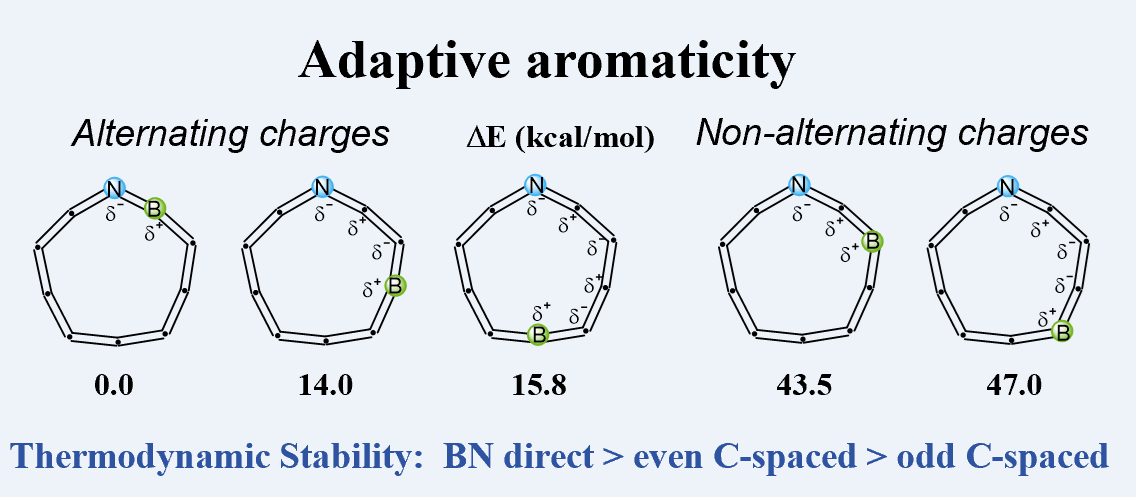
B,N-doped organic analogues can be widely used in photoelectronic materials, medicine and other fields. However, B,N-doped cyclo[n]carbons have not yet been developed. Herein, we report a systematic investigation of the thermodynamic stability and aromaticity of mono B,N-doped cyclo[10]carbon isomers via density functional theory (DFT). Several rules for thermodynamic stability have been proposed. Specifically, rule 1: isomers with B,N atoms separated by an even number of C atoms are more stable than those separated by an odd number of C atoms.
