
Synthesis of a Triply Twisted [54]Dodecaphyrin and Its Metal Complexes by Trimetal-Templated Strategy and Pd0-Induced Antiaromaticity
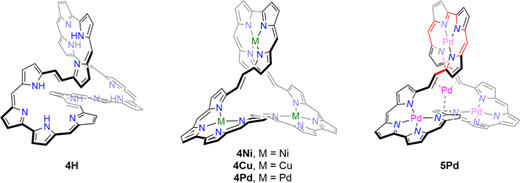
Molecular topology plays a key role in controlling the aromatic or antiaromatic character of cyclic π-conjugated systems. Herein we report synthesis of triply twisted [54]dodecaphyrin(2.1.0.1.2.1.0.1.2.1.0.1) tri-NiII complex 4Ni via reductive cyclization of cyclic tris(dipyrrin) NiII complex 3, which was synthesized by a tri-NiII templation. 4Ni was converted into free base 4H and CuII complex 4Cu. In contrast, treatment of 4H with Pd(OAc)2 produced a tetra-Pd complex (5Pd) containing an additional central Pd0 atom coordinated by three η2-ethylene units, which was converted into 4Pd upon mild oxidation. X-ray crystallographic analyses of 4Ni, 4H, 4Cu, and 4Pd revealed their triply twisted Möbius topologies as the first example of triply twisted expanded porphyrin, while the spectroscopic and computational studies indicated essentially nonaromatic electronic structures. In contrast, 5Pd shows a weak but distinct antiaromaticity as supported by 1H NMR, NICS, and ACID analyses. The paratropic response arises from metal-mediated local electronic circuits involving the Pd0 center rather than the global Möbius conjugation. These results highlight the potential of metal−π interactions for controlling aromaticity in highly twisted expanded porphyrins.