
From Benzene to [3]Radialene: Topological Engineering of Pure Hydrocarbons for Long-Wavelength Aggregation-Induced Emission Luminogens
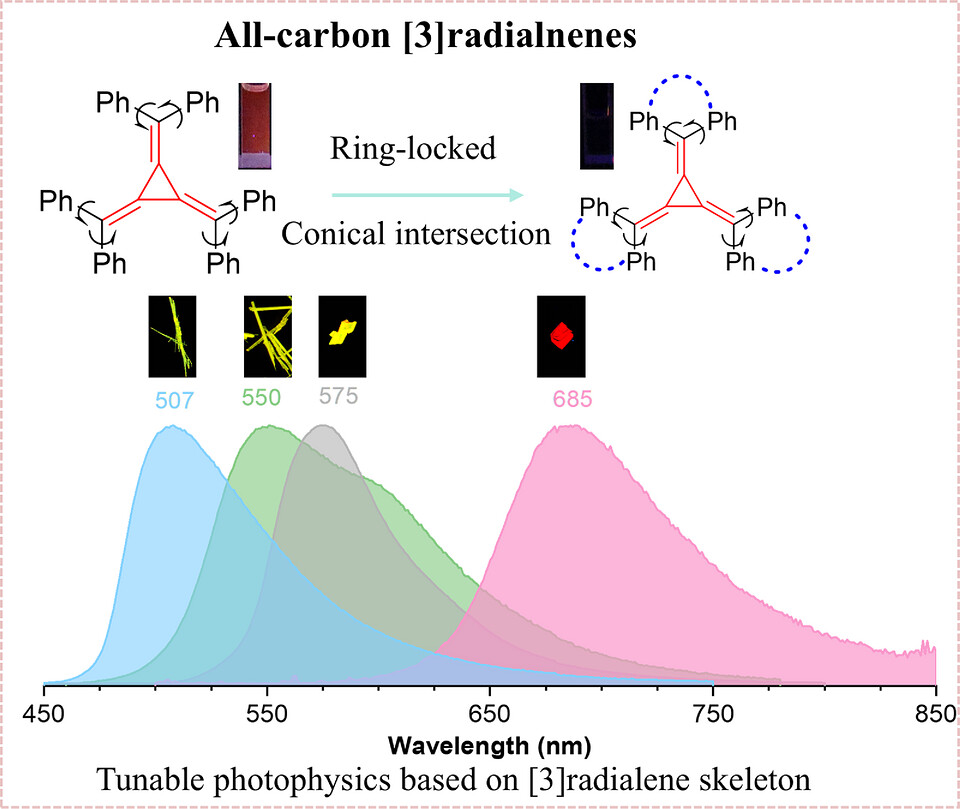
Due to the topological divergence between [3]radialene and benzene, hexaphenyl[3]radialene exhibits a dramatic bathochromic shift in emission (619 nm) with a Stokes shift >150 nm, which is distinct from its structural analogue hexaphenylbenzene. Our mechanistic analyses revealed the localized bond rearrangement and moderate short-range charge transfer, which lead to its long-wavelength emission and enhanced aggregation-induced emission character. Ring-locked derivatives, tridibenzocycloheptadiene[3]radialene and tridimethylanthracene[3]radialene (TAR), were synthesized, exhibiting tunable emission wavelength (507–685 nm) and high crystalline-state quantum yields (up to 49.2%). Finally, the potential of TAR for lysosome-targeting bioimaging was demonstrated. Our results establish the [3]radialene backbone as a robust hydrocarbon scaffold for high-performance, long-wavelength emitters.