antiaromaticity

Stabilizing Two Classical Antiaromatic Frameworks: Demonstration of Photoacoustic Imaging and the Photothermal Effect in Metalla-aromatics

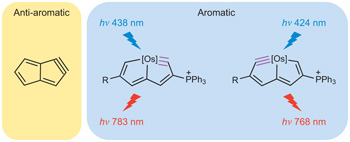
Antiaromatic species are substantially less thermodynamically stable than aromatic moieties. Herein, we report the stabilization of two classical antiaromatic frameworks, cyclobutadiene and pentalene, by introducing one metal fragment through the first [2+2] cycloaddition reaction of a late-transition-metal carbyne with alkynes. Experimental observations and theoretical calculations reveal that the metal fragment decreases the antiaromaticity in cyclobutadiene and pentalene simultaneously, leading to air- and moisture-stable products.

Stabilization of anti-aromatic and strained five-membered rings with a transition metal

Anti-aromatic compounds, as well as small cyclic alkynes or carbynes, are particularly challenging synthetic goals. The combination of their destabilizing features hinders attempts to prepare molecules such as pentalyne, an 8π-electron anti-aromatic bicycle with extremely high ring strain. Here we describe the facile synthesis of osmapentalyne derivatives that are thermally viable, despite containing the smallest angles observed so far at a carbyne carbon.

Pages