
Probing the adaptive aromaticity in a series of mono B,N-doped cyclo[10]carbons and the general rules for their thermodynamic stability
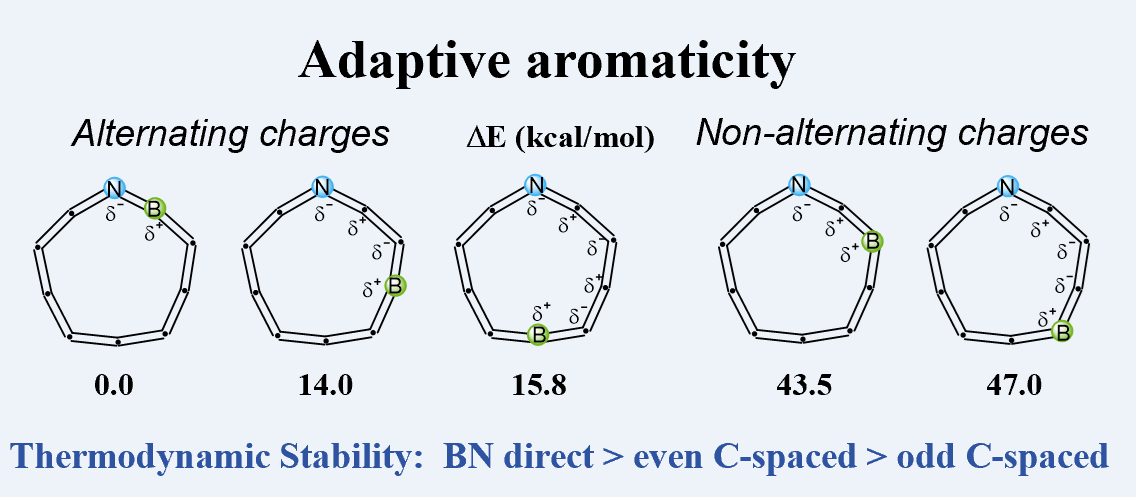
B,N-doped organic analogues can be widely used in photoelectronic materials, medicine and other fields. However, B,N-doped cyclo[n]carbons have not yet been developed. Herein, we report a systematic investigation of the thermodynamic stability and aromaticity of mono B,N-doped cyclo[10]carbon isomers via density functional theory (DFT). Several rules for thermodynamic stability have been proposed. Specifically, rule 1: isomers with B,N atoms separated by an even number of C atoms are more stable than those separated by an odd number of C atoms. Additionally, rule 2: the isomer is the most stable when the electron-deficient B atom and the electron-rich N atom are directly bonded. The above two rules are validated by examining the thermodynamic stability of other cyclo[n]carbon (n = 6, 14, 18, 22) systems. Furthermore, rule 3: as the ring size increases (n = 6→22), the energy gap between the most unstable isomer with B,N atoms separated by an even number of C atoms and the most stable isomer separated by an odd number of C atoms gradually diminishes. Moreover, the relative energies of the isomers become closer because the enlarged ring dilutes the effect of charge undistribution. In addition, the isomers of B,N-doped cyclo[10]carbon are proved to show aromaticity in both the S0 and T1 states (termed adaptive aromaticity) based on a series of aromaticity indices. Further analysis reveals that the B,N-doped isomers are in-plane ππ* excitation pattern, which has a negligible effect on aromaticity because the out-of-plane π orbitals make the dominant contribution to aromaticity. Our findings invite chemists to synthesize such thermodynamically stable isomers and further enrich the family of adaptive aromatics.