
Decoding Tunable Ring-Specific Adaptive Aromaticity in 1,3-Diaza-5,6-Diborabicyclo[3.1.0]hexatriene: Insights from a Combined DFT and Machine Learning Study
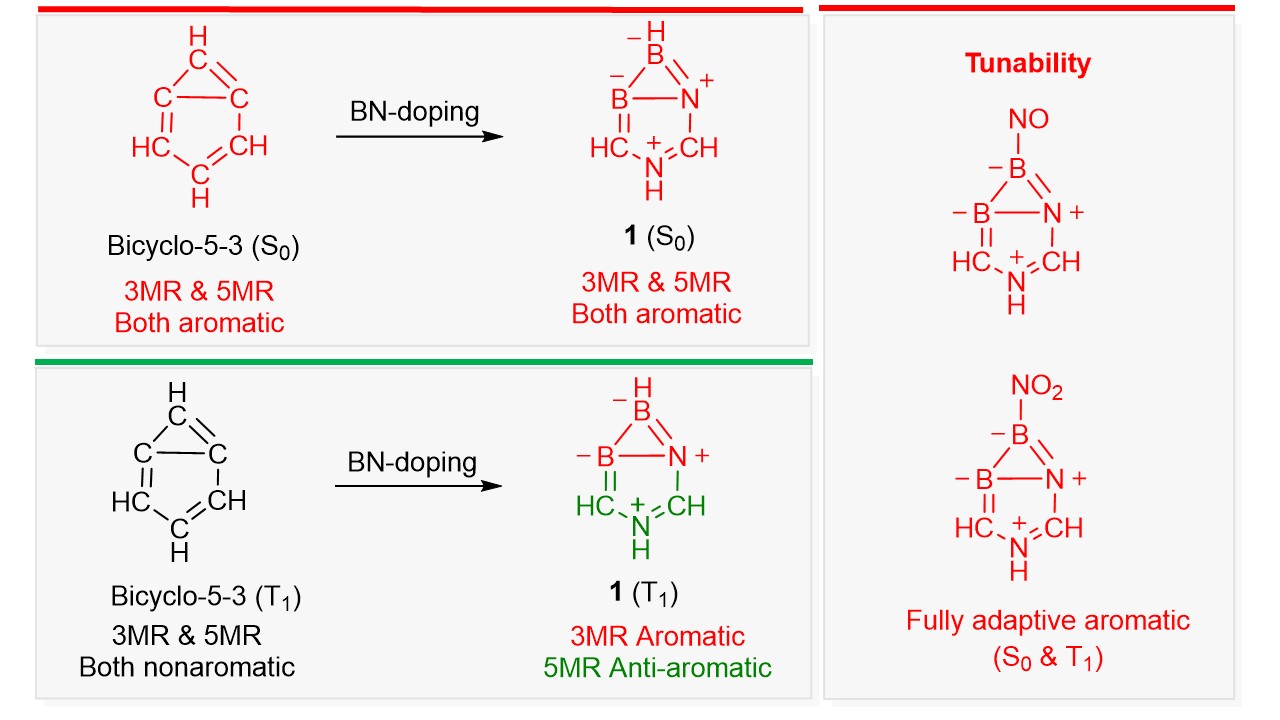
Aromaticity, a cornerstone of chemical stability, is governed by Hückel’s and Baird’s rules for the ground (S0) and triplet excited (T1) states, respectively, yet these canonical rules are challenged by two-state aromaticity (adaptive aromaticity)—a burgeoning frontier in aromaticity research. Herein, density functional theory (DFT) investigations reveal that 1,3-diaza-5,6-diborabicyclo[3.1.0]hexatriene (1) and its all-carbon congener both exhibit S0 entire-fused system aromaticity, but show striking T1 divergence: the carbon analog loses aromaticity entirely, while compound 1 displays ring-specific adaptive aromaticity (5MR antiaromatic, 3MR aromatic). Nitroso/nitro substituents act as potent spin modulators, enabling switching between localized and whole-system T1 aromaticity. A multiple linear regression model identifies spin localization and charge distribution as the principal contributors to T1-state electron delocalization within the present dataset, while an Extreme Learning Machine (ELM) classifier reproduces the DFT-derived aromaticity categories with 93% accuracy on the held-out entry-level test set. This combined DFT–ML strategy provides a complementary data-driven framework for analyzing adaptive aromaticity in BN-doped heterocyclic systems.